ChatGPT Traffic Drop Is a Tracking Problem, Not a Loss
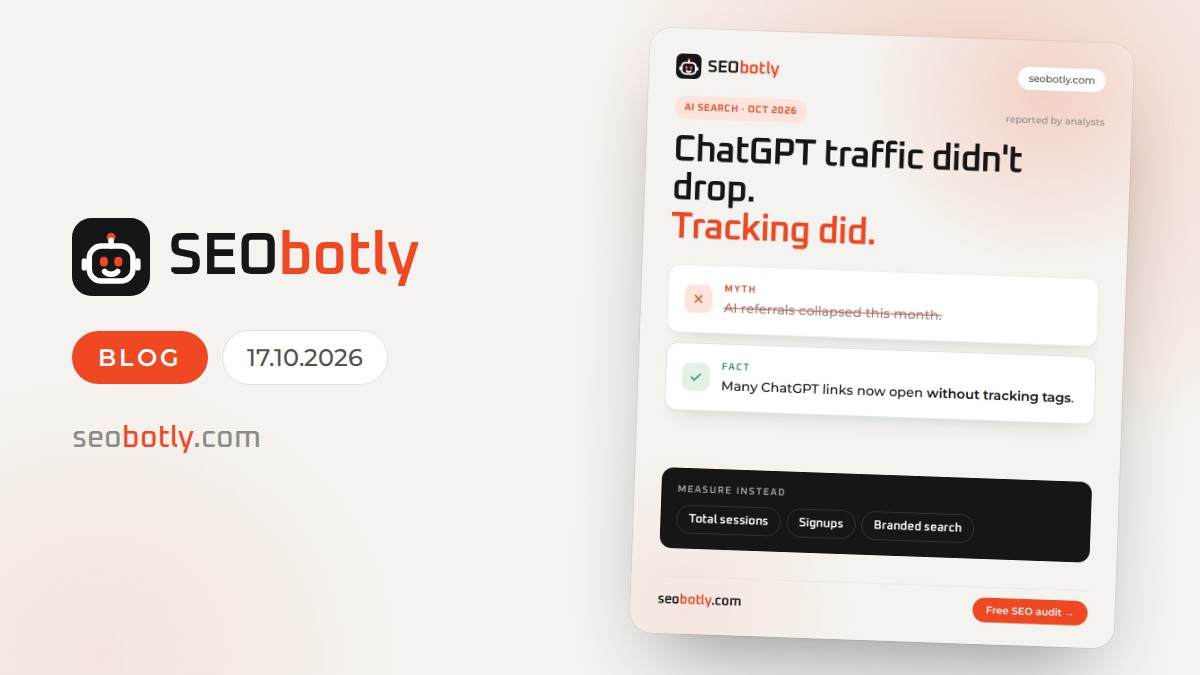
If your ChatGPT referral numbers fell off a cliff this month, don't panic-rewrite your content strategy. Analysts tracking the drop say it looks like an attribution artefact: ChatGPT links are opening without tracking tags, so the same visitors land in your "direct" bucket instead of the AI referral bucket. The traffic may well still be there, the label broke, not the demand.
What actually changed
Search Engine Journal reported that ChatGPT-attributed traffic fell sharply across several analytics datasets, with analysts tying the decline to ChatGPT links that open without the tracking parameters analytics tools rely on to identify the source.
That detail matters more than it sounds. Most analytics platforms classify a session by two signals: the referrer header and any campaign parameters appended to the URL. Strip both, or deliver the click in a context where neither survives, and the session has no origin story. It becomes "direct": the dumping ground for every visit an analytics tool cannot explain.
So the pattern you'd expect from a measurement break is exactly the pattern many sites are seeing: AI referrals collapse, direct traffic climbs by a suspiciously similar amount, and total sessions barely move. That's a labelling change, not a demand change.
How to confirm it on your own site
- Pull total sessions for the last 60-90 days. Did the overall line dip at the same moment AI referrals did, or stay flat?
- Chart "direct" traffic on the same axis. If direct rose as AI fell, you have your answer.
- Check downstream conversions, signups, trials, demo requests, email captures. If those held steady, the audience never left.
- Look at landing page distribution. AI-driven visits often hit deep, specific pages rather than your homepage. If those same deep pages are still getting entries under "direct", that's the AI audience wearing a disguise.
Why referral data was always a bad proxy for AI visibility
Even when tracking works perfectly, referral counts understate AI's real influence. Ahrefs made this point in its guide on measuring AI search visibility when attribution falls short: when they looked at where signups actually came from, AI ranked ahead of YouTube and second only to Google, a picture they would have badly undersold if they had relied on referral traffic alone. Most AI influence happens out of sight.
Think about how people actually use assistants. Someone asks for the best tools in your category, reads a synthesised answer that names you, never clicks, then searches your brand name in Google two days later. Or they copy the recommendation into a Slack channel and a colleague types your URL manually. Or they click through on a phone where the referrer never makes it to your server. In every case you got value from the AI answer and zero credit in your referral report.
That's the structural reality: AI assistants are a discovery and consideration channel whose influence mostly lands as untracked demand. Referral traffic is the thin visible slice, not the whole thing.
The metrics that actually survive broken attribution
Build your AI reporting on signals that don't depend on a parameter surviving a redirect.
1. Branded search demand
Open Search Console, filter queries containing your brand name, and track impressions and clicks over time. When an assistant recommends you repeatedly, people go look you up. Rising branded search with flat non-branded search is one of the cleanest available proxies for growing AI visibility. It's also measured by Google, not by a third-party script, so it survives tagging changes entirely.
2. Presence in AI answers
Rather than counting clicks, count mentions. Build a list of the 30-80 prompts a real buyer in your category would type, comparison questions, "best X for Y", problem-framed queries, alternatives to competitors, and check how often your brand appears in responses, in what position, and whether you're cited with a link. Track the trend monthly. This is the closest thing to a rank tracker for AI surfaces, and it is unaffected by referral tagging. SEObotly runs this alongside your Search Console data, so AI visibility and organic clicks sit in the same view and one broken label doesn't skew the story.
3. Self-reported attribution
Add a "How did you hear about us?" field to signup or demo forms, with ChatGPT, Perplexity, Gemini and "AI assistant" as explicit options. It's imperfect and self-selecting, but it catches the entire dark-funnel path that analytics can't see. Many teams discover their AI share is multiples of what their referral report claimed.
4. Total outcomes, not channel labels
Make your top-line dashboard total sessions, total qualified signups and total revenue. Channel attribution becomes a secondary diagnostic layer. If the top line is healthy and a channel label moved, you have a measurement question, not a business emergency.
This is part of a wider measurement squeeze
AI referrals aren't the only data stream getting noisier. Search Engine Roundtable's recent news recap covered reports that Google appears to be feeding third-party tracking tools fake data and serving paywalls, causing problems for keyword tracking, alongside updates to AI results and changes coming to Discover.
The direction of travel is consistent: platform-mediated data is becoming less reliable and less granular. The defensible response isn't to find one perfect tool, it's to run two or three independent measurement systems and look for agreement between them. First-party data you own (server logs, CRM records, form answers) plus platform-owned data (Search Console) plus sampled AI visibility checks will tell you more than any single dashboard.
Your action checklist
- Overlay AI referrals, direct traffic and total sessions on one chart before concluding anything dropped.
- Check whether conversions moved. If they didn't, the audience didn't either.
- Set a baseline for branded search impressions and clicks in Search Console this week.
- Write 30-80 buyer-intent prompts and start logging whether AI answers mention and cite you.
- Add a self-reported "how did you hear about us" field to every conversion form.
- Annotate your analytics with the date the tracking change appeared so future you doesn't misread the dip.
- Shift your reporting narrative from "channel X sent N visits" to "total demand and where influence came from".
- Keep publishing the content that earned the AI citations in the first place, clear, specific, factual, easy to quote.
What not to do
Don't cut budget or kill a content programme because a referrer label disappeared. Don't rebuild your reporting around a single channel that a third party can redefine without notice. And don't chase every attribution patch, by the time you've engineered a workaround, the platform may have changed its link handling again.
The takeaway
A sudden collapse in one channel label, with flat totals and flat conversions, is a measurement event. Your visitors behaved the same; your analytics just got worse at describing them. The teams that will read AI search correctly over the next few years are the ones measuring presence, are we in the answer, are we named, are people searching for us afterwards, rather than relying on a referral tag that was never designed for a world where the recommendation happens before the click.