AI Overviews Hit 83% of Branded Searches: What to Do
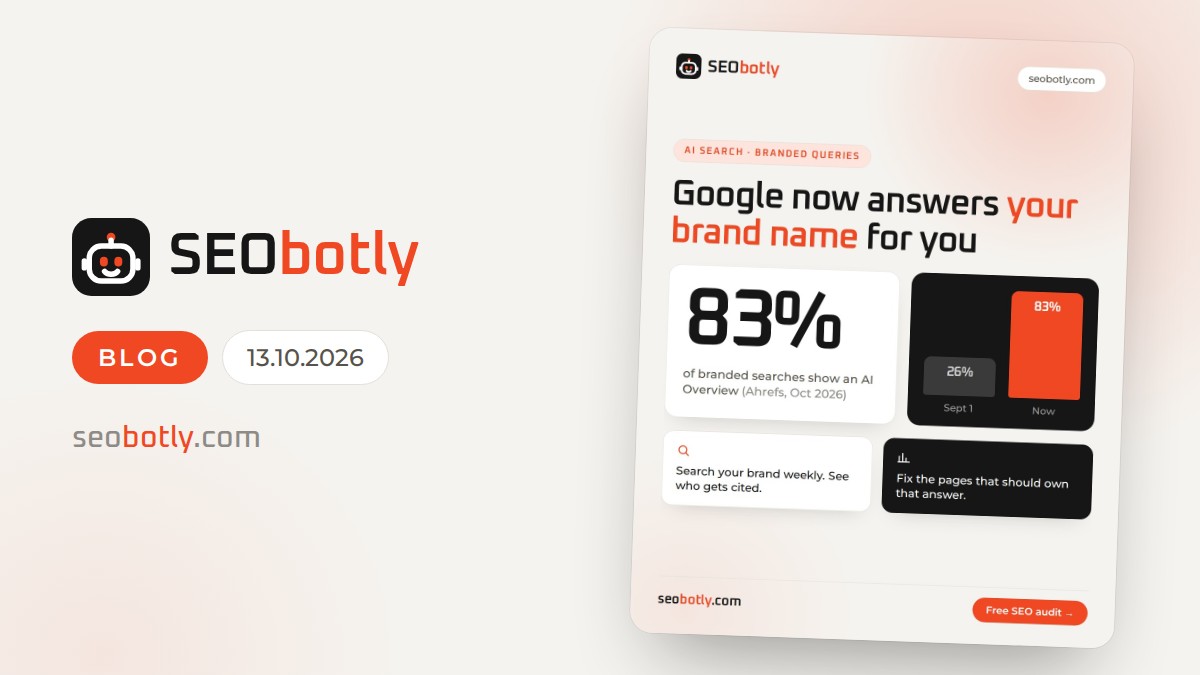
Google now generates an AI Overview for the vast majority of brand-name searches. Ahrefs found AI Overviews appearing for 83% of branded queries, and data from DemandSphere shared by Semrush shows the same pattern: a jump from 26% on September 1 to more than 80% of the branded queries they monitor. If someone types your company name, Google will likely summarize who you are before they ever reach your homepage.
That changes the economics of your most valuable keyword — your own name. Here's what shifted, who it affects, and the concrete steps to take this week.
What actually changed
Branded searches used to be the safest traffic a company had. Someone types your name, your site ranks first, they click. Low competition, high intent, predictable.
Now Google increasingly inserts a generated summary above those results. According to Ahrefs' analysis of AI Overviews on branded searches, that summary shows up for 83% of branded queries they tested. Semrush, reporting on DemandSphere's tracking data, documented the same trend line — a rise from roughly a quarter of branded queries at the start of September to over 80%.
Google has not published an explanation for the shift. From the outside it looks like a deliberate expansion of AI Overview coverage into query types that were previously left alone — navigational and brand-name searches where the user's intent seemed obvious.
Why this matters more than a generic ranking drop
Two reasons.
First: clicks. An AI Overview that answers "what is [your brand]" removes the need to visit your site. Ahrefs notes the potential for reduced clicks to brands' own websites. Even if the summary is accurate and flattering, a user who got what they needed doesn't continue to your pricing page.
Second, and more important: who gets to describe you. AI Overviews pull from and cite third-party sources — Wikipedia entries, YouTube videos, review sites, directory listings, press coverage. That means a competitor's comparison post, an outdated Wikipedia paragraph, or a two-year-old review roundup can end up as the authoritative description of your company, shown to someone who typed your name specifically to hear from you.
This is a brand control problem disguised as an SEO problem.
Who is affected
- SaaS and software companies — comparison and alternatives content about you already outranks you for some branded modifiers; now it can feed the summary.
- Ecommerce and DTC brands — review aggregators and marketplace listings are prime citation material.
- Local and service businesses — directory profiles and third-party listings often carry stale hours, pricing, or service descriptions.
- Anyone running brand-term paid search — your cost per click assumptions were built on a SERP that no longer exists in the same form.
- Newer or smaller brands — with thin third-party coverage, summaries may be assembled from whatever scraps exist, which is often worse than nothing.
Step one: audit what Google says about you
You cannot fix what you haven't read. Start with a manual sweep, then systematize it.
- Search your exact brand name in a logged-out or incognito window. Read the AI Overview word for word. Is it accurate? Current? Does it mention a product you sunset?
- Note every cited source. Which domains does Google link inside and beside the overview? Are you one of them, or is it all Wikipedia, YouTube, and review sites?
- Repeat for branded modifiers: "[brand] pricing", "[brand] reviews", "[brand] alternatives", "[brand] vs [competitor]", "is [brand] legit", "[brand] login", "[brand] customer service".
- Do the same for your top two competitors. If their overview is cleaner than yours, look at what sources it leans on.
- Log the results in a sheet with the date, the summary text, and the citation list. One snapshot tells you nothing; a weekly series tells you whether your fixes are landing.
Make it a weekly habit, not a one-off project
AI Overview output is unstable. The same query can return different summaries and different citations week to week. Checking once in January and declaring victory is how brands get surprised in March. Put a recurring fifteen-minute block on the calendar.
Step two: fix the pages that should be cited
If third-party sources are winning the citation slots, it's usually because your own pages don't answer the question in a quotable way. The fix is unglamorous and effective.
Your About page. Most About pages open with mission-statement poetry. Open instead with a plain factual paragraph: what the company is, what it does, who it serves, when it was founded, where it's based. Write the sentence you'd want a search engine to lift verbatim.
Your pricing page. Put actual numbers in text, not inside images or JavaScript-rendered widgets. If pricing is custom, say so explicitly and describe the ranges or the factors that determine cost. "Contact us" alone gives the model nothing, so it goes to a review site that guessed.
Your comparison pages. If you don't publish an honest "[your brand] vs [competitor]" page, someone else's version becomes the reference. Be specific, be fair, and include the cases where the competitor is the better fit — balanced comparisons tend to survive scrutiny better than sales sheets.
A real FAQ. Collect the questions support actually receives and answer them in short, direct paragraphs. Is the product secure? How does billing work? What's the refund policy? These map directly onto branded modifier queries.
Your third-party footprint. Update your Wikipedia entry if you qualify for one and follow their rules. Claim and refresh directory and review profiles. Make sure your YouTube channel has a current product overview video. These are the sources getting cited — being accurate there is as important as your own site.
Step three: change how you measure
Brand clicks in Search Console may decline while brand impressions hold steady or rise. That gap is the AI Overview absorbing demand. Treat it as a signal, not a failure.
Adjust your reporting accordingly:
- Split branded from non-branded queries in Search Console and track them separately.
- Watch impressions-to-clicks on brand terms as a trend line, not a monthly number.
- Track direct and referral traffic alongside organic — some displaced clicks resurface as direct visits later.
- Record citation share: of the sources Google cites for your brand queries, how many are yours?
- Review branded paid search performance, since the SERP layout above your ad changed.
This is exactly the kind of cross-referencing SEObotly is built for — it tracks brand mentions and citations inside AI answers next to your Search Console click data, so you can see whether a dip in brand clicks lines up with an overview appearing.
Quick checklist
- Search your brand name weekly, logged out, and save the AI Overview text.
- Record which domains get cited — and whether yours is among them.
- Repeat for pricing, reviews, alternatives, and "is it legit" modifiers.
- Rewrite your About page opening as plain, factual, quotable copy.
- Put real pricing information in crawlable text.
- Publish your own honest comparison pages.
- Build an FAQ from actual support questions.
- Update Wikipedia, review profiles, directories, and YouTube.
- Separate branded from non-branded metrics in reporting.
- Re-check competitor overviews to see what's working for them.
The takeaway
At 83% coverage, AI Overviews on branded searches are no longer an edge case to monitor — they're the default experience for people looking you up. You can't opt out of the summary, but you can heavily influence what goes into it by being the clearest, most current, most structured source of information about your own company.
The brands that do well here won't be the ones who gamed a format. They'll be the ones whose own pages were simply the best available answer to "what is this company and should I trust it." Start by reading what Google says about you today.